
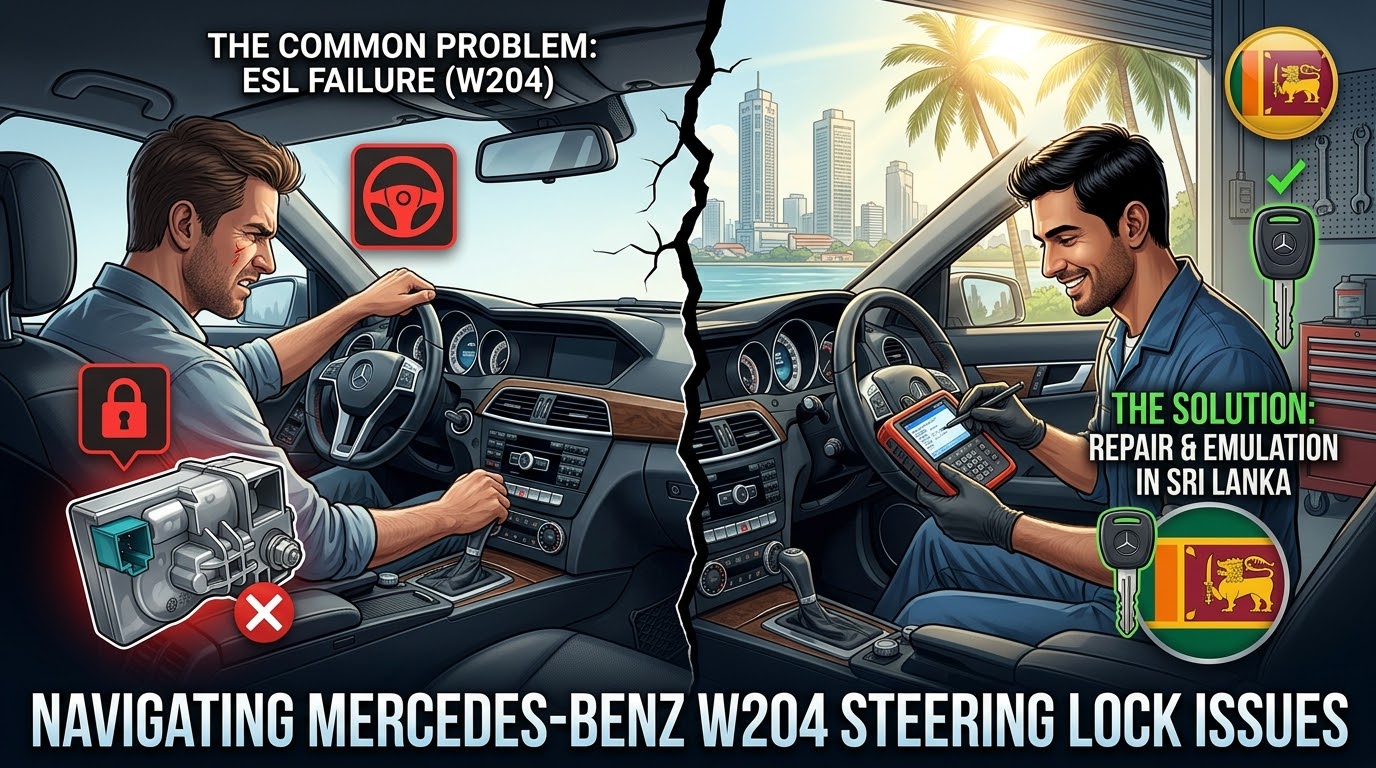
<span;>Common Steering Lock (ESL) Issues in Mercedes-Benz W204 C-Class and Solutions in Sri Lanka
<span;>If your Mercedes-Benz W204 C-Class suddenly won’t start, shows a “Steering Lock” warning on the dashboard, or the steering wheel feels locked even though the key is turned, you’re likely dealing with a failing Electronic Steering Lock (ESL), also known as ELV (Elektronisches Lenkradschloss) in Mercedes terminology. This is one of the most common and frustrating electronic faults on the W204 platform, and it’s especially prevalent here in Sri Lanka due to our climate, road conditions, and the age of most imported W204s currently on the road. This article explains what the ESL does, why it fails, how to recognize the symptoms, and what your realistic repair options are locally.
<span;>What Is the ESL/ELV System?
<span;>The Electronic Steering Lock replaced the traditional mechanical key-and-tumbler steering lock found in older cars. In the W204, a small electric motor inside the steering column locks and unlocks the steering shaft automatically whenever you insert or remove the key (or, on keyless models, when you press the Start/Stop button). The ESL communicates with the ignition switch module, the EIS/EZS (Electronic Ignition Switch), and the car’s CAN bus network to confirm the correct key is present before it will unlock the steering column and permit the engine to start.
<span;>Because this system sits at the intersection of mechanical wear and electronic control, it’s vulnerable to two very different types of failure: the motor and gears wearing out physically, or the electronics and software losing communication with the rest of the car.
<span;>Common ESL Symptoms on the W204
<span;>Owners in Sri Lanka typically report one or more of the following:
<span;>A “Steering Lock” or “Visit Workshop” message appearing on the instrument cluster
<span;>The engine cranks but won’t start, or won’t crank at all
<span;>The steering wheel remains physically locked even after the key is turned or the Start button is pressed
<span;>Intermittent faults — the car starts fine most days but occasionally refuses to unlock
<span;>A grinding or clicking noise from behind the steering column when starting the car
<span;>The car starts, but then randomly cuts off while driving (a more dangerous variant, as the ESL can re-engage while the wheel is in motion)
<span;>Dashboard warning lights (ESP, engine management) appearing alongside the steering lock fault, since the systems share communication lines
<span;>Why ESL Failures Are So Common in Sri Lanka
<span;>A few local factors make this a particularly frequent complaint here compared to markets with better climate control and newer vehicle stock:
<span;>Humidity and moisture ingress. Sri Lanka’s tropical, humid climate accelerates corrosion on the small electrical contacts and connector pins inside the steering column assembly. Over time, this leads to poor connections and intermittent faults long before the mechanical motor itself wears out.
<span;>Age and mileage of imported W204s. Most W204s on Sri Lankan roads are reconditioned imports, typically already 8-15 years old with high mileage from their country of origin. The ESL motor has a wear-driven lifespan (Mercedes itself has acknowledged this as a known weak point across the model line), so by the time these cars reach Sri Lankan owners, many are already near end-of-life for this component.
<span;>Voltage fluctuations and battery issues. Unstable charging systems, aftermarket batteries with inconsistent quality, or a weak/dying battery can cause the ESL module to behave erratically, since it needs stable voltage to complete its unlock sequence correctly.
<span;>Dust and short trips in city traffic. Frequent stop-start driving in Colombo traffic, combined with dust ingress through the steering column area, adds mechanical stress to the ESL’s small internal gears.
<span;>Root Causes: Mechanical vs Electronic
<span;>It’s important to distinguish between the two failure types, because the repair approach differs:
<span;>Mechanical wear — The ESL motor’s internal gears or the locking pin mechanism physically wear out from years of use. This is a pure hardware failure and is the most common cause on higher-mileage cars.
<span;>Electronic/software faults — The ESL loses its “handshake” with the EIS or the car’s central gateway module, often due to corrosion, a failing solder joint on the ESL circuit board, or a software fault requiring recalibration. This can happen even on lower-mileage vehicles.
<span;>Battery-related false faults — Sometimes there’s nothing wrong with the ESL at all; a weak battery or bad earth connection simply prevents it from completing its unlock cycle, and it throws a fault code as a result.
<span;>Diagnosing the Fault Correctly
<span;>Because the symptoms overlap heavily between these causes, proper diagnosis with a Mercedes-compatible diagnostic scanner (such as Xentry/DAS or a quality aftermarket tool that can read Mercedes-specific fault codes) is essential before any parts are replaced. A shop should check:
<span;>Battery voltage and charging system health first, since this is the cheapest thing to rule out
<span;>Fault codes stored in the EIS, ESL, and related control modules
<span;>Physical inspection of the steering column wiring loom for corrosion or damage
<span;>Whether the fault is consistent or intermittent, which points toward mechanical vs. connection-related causes
<span;>Replacing the ESL unit without proper diagnosis is one of the most common (and expensive) mistakes owners make, since a battery or wiring issue can mimic ESL failure symptoms almost exactly.
<span;>Solutions Available in Sri Lanka
<span;><span;>1. <span;><span;>ESL Repair (Reconditioning)
<span;>Rather than replacing the entire unit, many specialist workshops now offer ESL repair kits that replace only the worn motor and gear assembly inside the original housing, while retaining the original electronics. This is significantly cheaper than a full replacement and avoids the complex coding process needed for a brand-new unit, since the original module’s identity and coding to your specific car are preserved. This is the most cost-effective and widely used solution in Sri Lanka today.
<span;>2. Full ESL Replacement with Coding
<span;>If the electronics themselves have failed (not just the motor), a full replacement unit may be required. This is more expensive and requires the new ESL to be properly coded to the vehicle using Mercedes diagnostic software, matching it to the EIS and the vehicle’s identity so the anti-theft system recognizes it. This should only be done by a workshop with genuine Mercedes-Benz diagnostic capability.
<span;>3. Sourcing Genuine or Quality Parts
<span;>Because genuine Mercedes-Benz ESL units and repair kits are not manufactured locally, availability and pricing depend heavily on import access. This is where working with an established Mercedes-Benz spare parts supplier matters — genuine or OEM-equivalent components with proper compatibility for W204 chassis and production-year variations (early vs. facelift models can differ) reduce the risk of recurring faults and failed coding attempts.
<span;>4. Addressing Root Causes Alongside the Repair
<span;>A proper repair should also include cleaning and protecting the connector contacts against future moisture ingress, checking the battery and charging system, and verifying the vehicle’s earth points — otherwise, the same fault can return within months even after a good repair.
<span;>Preventive Tips for W204 Owners
<span;>Keep your battery and charging system in good condition; a weak battery stresses the ESL unnecessarily every time you start the car
<span;>Avoid aftermarket “universal” ESL repair kits of unknown origin, as fitment tolerances on the W204 are tight
<span;>If you notice occasional hesitation when starting or intermittent dashboard warnings, get it diagnosed early rather than waiting for a complete failure, which often happens at the worst possible time (and sometimes while driving)
<span;>Have the steering column area inspected periodically for signs of moisture or corrosion, particularly if the car is parked outdoors often
<span;>Why This Matters When Choosing a Repair Partner
<span;>Because the ESL is tied directly into the vehicle’s anti-theft and immobilizer system, any repair or replacement needs correct parts matched to your car’s specific model year and correct coding procedures to avoid creating new faults. Working with a supplier and workshop that understands the W204 platform specifically — rather than treating it as a generic “European car electrical fault” — makes a real difference in both repair cost and long-term reliability.
<span;>If you’re experiencing steering lock symptoms on your W204, getting a proper diagnosis before ordering parts will save you money and downtime. Feel free to get in touch with us for genuine and quality-tested ESL components, repair kits, and guidance suited to Mercedes-Benz vehicles on Sri Lankan roads.

